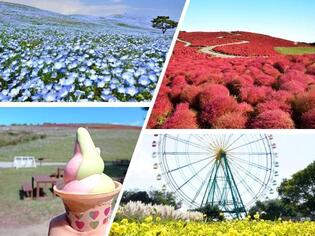




Nemophila at Hitachi Seaside Park
This is a spectacular spot where countless nemophila flowers bloom. Many people visit to see the magnificent blue scenery of Miharashi Hill.
 Hitachi Seaside Park
 Ryujin Suspension Bridge
 Oarai Beach
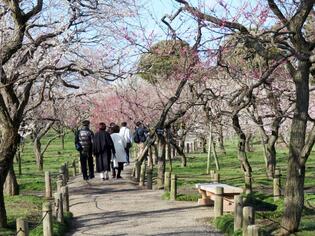
Ibaraki Prefecture is rich in nature, parks, historical buildings, and other attractions. There are many famous places and attractions nationwide, such as Kairakuen, one of Japan's three most famous gardens, Fukuroda Falls, one of Japan's three most famous fireworks, and the Tsuchiura National Fireworks Competition, one of Japan's three largest fireworks festivals. There are also many spots where you can enjoy seasonal flowers, and the plum blossoms in Mito, the nemophila at Hitachi Seaside Park, and the irises in Itako are must-sees.
Ibaraki in spring is a great place to enjoy seasonal flowers. The cherry blossoms at Kairakuen and Hitachi Fudoki-no-Oka are beautiful, but the spectacular view of the nemophila flowers that paint the entire hill at Hitachi Seaside Park a deep blue is a must-see spot.
This is a spectacular spot where countless nemophila flowers bloom. Many people visit to see the magnificent blue scenery of Miharashi Hill.

One of the three most famous gardens in Japan, you can enjoy the beautiful scenery of the Japanese garden and seasonal flowers, including the Sakon no Sakura.

This leisure facility utilizes the city's historical assets. It is also known as a famous cherry blossom viewing spot with 500 cherry trees in bloom, where you can enjoy cherry blossom viewing for about a month.

The Great Buddha is the largest in the world. In spring, you can admire the combination of cherry blossoms and the Great Buddha, as if they are standing amongst the cherry blossoms and moss pinks.

The promenade surrounding Lake Senba is lined with rows of cherry blossoms in spring, allowing you to enjoy walking or jogging while admiring both the lake and the cherry blossoms.
Ibaraki in the summer is full of attractive spots. You can enjoy summer in any way you like, such as cycling on the Tsukuba Kasumigaura Ring Ring Road or cooling off at the Aqua World Ibaraki Oarai Aquarium.

This is a cycling course where you can enjoy the scenery that changes with the seasons. You can feel the rich nature and fresh breezes to your heart's content.

The sight of about 1 million double-flowered sunflowers in full bloom with Mount Tsukuba in the background is overwhelming. During the festival, there is also a "cut flower garden" of double-flowered sunflowers.

The largest aquarium in Japan, it has nine areas where you can encounter a wide variety of marine life, including over 50 types of sharks.

The coast is made up of five consecutive coves and 50m high cliffs. At Goura Misaki Park, you can enjoy a bird's-eye view of the impressive coves.

A complex that offers a variety of experiences, including the planetarium, where you can enjoy the most beautiful starry sky that can be seen from the ground.
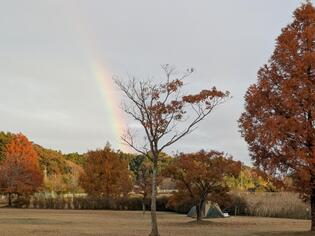
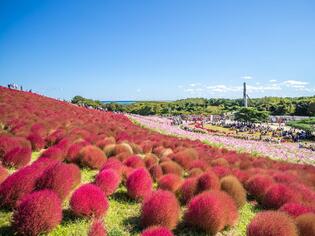
In autumn, Ibaraki offers spectacular views of autumn foliage. In addition to the collaboration between the majestic nature of Mount Tsukuba and Ryujin Suspension Bridge and the autumn leaves, the Hitachi Seaside Park, where the Kochia Hills turn bright red, is also a sight to behold.

It is nicknamed "Purple Peak" because its appearance changes many times a day, and you can enjoy the ever-changing mountainside and seasonal nature on a hike or drive.

The kochia flowers cover the hills in a deep red. They gradually change color from around October, and one way to enjoy them is to admire their changing colors from green to red to gold.

Japan's largest suspension bridge spans the Ryujin Dam. In autumn, you can enjoy hiking trails colored by autumn leaves and Hitachi Aki Soba noodles.

This roadside station was designed with the concept of being a "gateway to Kasama." You can enjoy the charms of Kasama City, including gourmet food made with local ingredients and a direct sales store.

A facility where you can experience the seasons with all five senses through flowers and nature. You can also enjoy a direct sale store and restaurant where you can savor local specialties and ingredients, as well as mountain activities.
Ibaraki in winter is a great place to enjoy scenery, gourmet food, and shopping. Be sure to check out the spectacular views of Fukuroda Falls and the fresh seafood at Oarai Seafood Market. Ami Premium Outlets also holds a biannual sale.

One of the three most famous waterfalls in Japan. It is also known as the "Four-time waterfall" because its charm can only be fully appreciated if you visit in each season.

This market allows you to taste seafood freshly caught at Oarai Fishing Port. You can enjoy fresh fish from every angle, whether it's served in a bowl or on a grill.

This roadside station allows you to rediscover the charms of Joso and Ibaraki through food. In addition to being able to buy local specialties, it also has a restaurant where you can enjoy Hitachi beef and seafood.

Popular domestic and international brands are gathered in a facility modeled after the American West Coast, offering a shopping experience in an exotic building.

A facility leading Japan's space development. There is also an exhibition hall where you can experience real space development up close, and an actual rocket is on display.

Mito City
A famous plum blossom spot throughout Japan, Kairakuen Garden in Mito is one of the three most famous gardens in Japan, along with Kenrokuen Garden in Kanazawa and Korakuen Garden in Okayama. It was opened in 1842 during the late Edo period by Tokugawa Nariaki, the ninth lord of the Mito domain, and remains to this day. Approximately 100 varieties of plum trees are planted, and the Mito Plum Festival, a seasonal event in early spring, is held from mid-February to March, attracting many people who come to see them. As the seasons progress, cherry blossoms, azaleas, autumn bush clover, and biseasonal cherry blossoms in early winter all reach their peak, making it a spot that can be enjoyed all year round. The large garden is full of attractions other than the seasonal flowers, including Kobuntei, designed by Nariaki himself, and the Moso Bamboo Grove.
Learn more
Mito City
Kairakuen Kobuntei is located after passing through the Moso bamboo forest and the cedar forest of Kairakuen. It consists of the two-story, three-storey Kobuntei main building and the single-storey inner palace, and together they are called Kobuntei. The plum tree is also known as "Kobunboku" (Kobun tree), and the name Kobuntei comes from this. It is said that Tokugawa Nariaki himself designed the location within the garden, the design of the building, and even the fine details, and although it has a simple appearance, it is filled with ingenuity and culture in every detail. Nariaki is said to have invited his vassals, literati, and even his subjects here to hold poetry readings and relaxation parties. The highlight of Kobuntei is the Rakujuro, which offers a magnificent view of Lake Senba in the foreground and Mount Tsukuba in the distance. Kobuntei, where Tokugawa Nariaki put his thoughts into, is a must-see tourist spot.
Learn more
Mito City
Kodokan, the largest han school in Japan, was founded by Tokugawa Nariaki in 1841 as the han school of the Mito domain. Aiming to provide an education that is both literary and martial, it was a place to study not only martial arts but also all kinds of academic subjects such as Confucianism and Dutch studies, making it an educational institution equivalent to a modern-day university. Based on the idea of "one step, one relaxation," it was also a place to "study while being proper," in contrast to Kairakuen, which was a "place to have fun together." The "Mitogaku" that developed at Kodokan influenced many patriots of the late Edo period and was a driving force behind the Meiji Restoration. It is a special national historic site and a Japan Heritage site for its educational heritage of early modern Japan. Like Kairakuen, it is a famous plum blossom spot, and during the Mito Plum Festival, approximately 800 plum trees are in full bloom, soothing the hearts of those who see them.
Learn moreMito City
Senba Lake Promenade is located in Senba Park, one of Mito's most famous parks, along with Kairakuen. The promenade, which encircles the lake at a circumference of about 3km, is a place where many local residents go for walks and jogs, and bicycles are available for rental. On the west side of the lake, there is a statue of Mito Komon and a D51 locomotive called "Degoichi," and there is also a space for children to enjoy. "Kobun Cafe" is a restaurant with a rooftop overlooking Senba Lake, and is also popular as a wedding venue. There are also other facilities on the lakeside, such as "Kobun Teahouse," "Children's Square," and "Boys' Forest" with field athletics, as well as a place of relaxation for local residents where you can view the many waterfowl that live on the lake. It is lit up at night, and you can enjoy the cherry blossoms on the promenade in spring, the cool lake breeze from the waterside deck that juts out over the lake in summer, the autumn leaves in autumn, and the swans that fly to the lake in winter.
Learn more
Mito City
Tokiwa Shrine is the largest shrine in Mito, dedicated to Mitsukuni Tokugawa, the second lord of the Mito Domain, and Nariaki Tokugawa, the ninth lord of the domain. Mitsukuni is popularly known both in history and in dramas as Komon-sama, and Nariaki was active at the end of the Edo period, founding Kairakuen Garden and Koudoukan, and both were prominent figures representing the Mito domain. In the Meiji era (1868-1912), people built a shrine in Kairakuen to commemorate the virtues of the two men, and it soon became Tokiwa Shrine by imperial decree. The Giryokan, named after Mitsukuni and Nariaki's posthumous names, Yoshikun and Ikkyokun, houses the "Great History of Japan," a major historical document, as well as other materials and valuable artifacts that tell the story of their achievements. Within the precincts of the temple are the war-defended Kaguraden (Hall of Shinto music and dance) and Nohgakuden (Noh theatre), where various Shinto rituals are performed. Since it is adjacent to Kairakuen Garden, it is recommended that you visit the two together.
Learn more
Mito City
Mito Komon is famous for his travels around the country. Mito Komon was the second lord of the Mito domain during the Edo period, Tokugawa Mitsukuni, and was so named because his official title was equivalent to the Chinese "Huangmen". The story that he traveled around the country and reformed the world is a later creation, but in fact he was known as a great ruler who made many achievements, such as compiling the history of Japan, and was loved by the common people. There are several statues of Mito Komon, a superstar of period dramas, in various places in Mito City, but the first one to greet you is the one located immediately after leaving the north exit of Mito Station. The familiar figure of a retired man leaning on a cane, surrounded by assistants and Kakusan in traveling clothes. The pedestal is not high, so you can take a commemorative photo with the statue, making it a famous spot in front of Mito Station.
Learn more
Kuji District
Fukuroda Falls is a representative tourist spot in Ibaraki Prefecture. With a height of 120m and a width of 73m, it is a national scenic spot, one of the three most famous waterfalls in Japan, and one of the top 100 waterfalls in Japan. It is also called "Yodo Falls" because it flows down the cliff in four tiers, or because Saigyo praised it, saying, "You can't enjoy this waterfall unless you come every season." As Saigyo said, you can see different spectacular views in each season, such as fresh green leaves, autumn leaves, and frozen waterfalls in winter. You can see the waterfall right before your eyes from the observation deck in the "Fukuroda Falls Tunnel," and you can enjoy the whole view of the waterfall from the second observation deck. There is also a suspension bridge that blends into the waterfall and the surrounding nature. The limited-time light-up event "Daigo Light" has become a new seasonal feature.
Learn more
Kuji District
Tsukimachi Falls, a scenic spot and a power spot, is 17 meters high and 12 meters wide. Normally it is a husband and wife waterfall with two rivulets, but when the amount of water increases, a third rivulets appears in the middle, making it a parent-child waterfall with a child waterfall included. Because of this, it has been a place of worship for safe childbirth and child-rearing since ancient times, and on the night of the 23rd night, women and children would gather and wait for the moon to rise, a ceremony called "23rd night lecture". The name "Tsukimachi Falls" comes from this, and even today, the Tainai Kannon is enshrined here. In addition, the rocks behind the waterfall are hollowed out, so you can enter the back without getting wet, and it is also called "Kuguri Falls" or "Ura-mi Falls". It is also famous as a spot to see autumn leaves, and in winter you can also see a frozen waterfall.
Learn more
Hitachiota City
This suspension bridge, which boasts the longest length in Japan, is located in Ryujin Gorge, a beautiful V-shaped valley in Okukuji Prefectural Natural Park, which is one of the 100 most scenic spots in Ibaraki. The bridge is 375m long, making it one of the largest pedestrian bridges in Japan. It is 100m above the surface of the dam lake, and offers a spectacular view of the surrounding area. This suspension bridge is sturdy, using the latest architectural techniques, and is designed to be safe even if 3,500 people are on the bridge at once and winds blow at 30m per second. Although it is a height that makes you shake your legs, you can cross it safely. The carillon "Morinokane" on both banks can resonate three different tones in the gorge, but the Bell of Love requires two people to press the button, making it particularly popular with couples.
Learn more
Tsukuba City
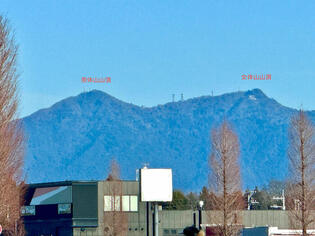
Mount Tsukuba is a famous mountain that has been called "Fuji of the West, Tsukuba of the East." It is a beautiful mountain that is also called "Purple Peak" because of the color of the mountain when it is dyed by the morning sun and the evening sun, and has been selected as one of the "100 Famous Mountains of Japan" and "Japan Night View Heritage." The mountain has been an object of worship since ancient times, and is a treasure trove of plants with over 1,000 species of plants growing in colonies. One of the reasons for its popularity is that you can enjoy climbing and hiking to see various plants, including the endemic "Hoshizaki Saxifrage." There are two peaks, Mount Nantai and Mount Nyotai, with Mount Nyotai at 877m and Mount Nantai at 871m. Although it is a low mountain, the view from the summit, located in the vast Kanto Plain, is outstanding. You can access the top of Mount Nantai by cable car and the top of Mount Nyotai by ropeway, so anyone can enjoy the view from the summit.
Learn moreTsukuba City
JAXA Tsukuba Space Center is the base of Japan's space development business. Opened in 1972, it develops and tests satellites and rockets, trains astronauts, and controls satellites in operation. In addition to visiting the exhibition hall "Space Dome," there are reservation-based and paid tours, and an occasional rocket launch sound experience. In the "Rocket Square" just inside the main gate, a real 50m-tall "H-II rocket" is on display. In the "Space Dome," a one-millionth scale model of the Earth, a life-size model of the Japanese Experiment Module of the International Space Station "Kibo," as well as actual satellites and test models are on display, allowing visitors to learn about the history of Japan's space development from the past to the cutting edge.
Learn more
Hitachinaka City
Hitachi Seaside Park is famous for the spectacle of flowers blooming all over its vast hills. The vast park is divided into seven areas, and in addition to being able to enjoy seasonal flowers, it is a national park where you can also enjoy an amusement park, athletics, and barbecues. The most famous "Miharashi no Hill" is the highest point in Hitachinaka City, and in spring, about 5.3 million nemophila flowers paint the hill blue, creating a fantastical world where they blend with the colors of the sky and sea. From summer to autumn, the hill is filled with kochia (broom grass), which resembles a marimo, and creates a different landscape with new greenery and autumn leaves. Other seasonal flowers can be seen in the park, such as daffodils, sunflowers, and cosmos. The large Ferris wheel "Blue Eyes" offers a panoramic view of the vast park and the Pacific Ocean from 100 meters above sea level.
Learn more
Hitachinaka City
Nakaminato Fish Market is a place where you can enjoy shopping for and eating fresh seafood. Located next to the fishing port of Nakaminato, the seafood sold there is only freshly caught that morning. Popular with its reasonable prices, it is a specialty shopping street representing the Kanto region, bustling with over 1 million shoppers every year. There are 12 stores lined up, including fish shops offering takeaway and restaurants with a port town feel, where you can enjoy seafood dishes such as generously served seafood bowls, sushi with seasonal ingredients, fresh sashimi, tempura, grilled fish and boiled fish set meals. In addition to flounder, which is the prefectural fish of Ibaraki Prefecture, anglerfish and other fish are also sold. Ibaraki Prefecture, which is a thriving fishing industry, is dotted with other seafood markets, and each region has its own characteristics, such as markets that sell a lot of fish from nearby waters and markets that sell a lot of fish caught in deep-sea fishing.
Learn more
Higashiibaraki District
This is one of Japan's largest aquariums, housing approximately 68,000 creatures from 580 species across 60 tanks of various sizes. Its symbolic shark collection includes the largest number of sharks in Japan, with approximately 60 species. The "Shark Daddy's Room" displays a stuffed great white shark and a megalodon jaw. Other popular marine creatures include ocean sunfish, tufted puffins, and approximately 10,000 moon jellyfish. The largest tank, the "Large Encounter Tank," hosts a program showcasing approximately 20,000 sardines moving like the aurora. The "Sea of Learning Zone" displays skeletal specimens and stuffed specimens of gigantic creatures such as right whales, sperm whales, and basking sharks. The aquarium also hosts fantastic night events featuring dolphins and sea lions, making this an endlessly entertaining aquarium.
Learn more
Higashiibaraki District
Oarai Sun Beach is a beautiful beach that stretches endlessly across the shallow Kashima Sea. It is well known for its clear waters and has been selected as one of the 100 Best Swimming Beaches by the Ministry of the Environment. It is a vast beach that stretches about 1km from north to south and 350m from east to west, but it is actually believed that the sand gathered there due to the impact of a breakwater built at Oarai Port in the north, and it is a relatively new beach that opened in 1984. It is famous for swimming, surfing, and clam digging, and also hosts new events such as a beach library and light-up events. The famous event held in the summer, the Oarai Seaside Fireworks Festival, is crowded with many people. As a barrier-free beach, it also offers free rental of amphibious wheelchairs, making it a beach that everyone can enjoy.
Learn more
Higashiibaraki District
Oarai Isosaki Shrine is known for the spectacular view of its torii gates standing on the reefs of Oarai, a scenic spot. From the coast where the torii gates are located, you can climb the stairs of Mt. Oarai to reach Oarai Isosaki Shrine. The torii gates on the coast are called "Kamiiso no Torii" (Sacred Iso Torii), and it is said that the enshrined deity descended to this place in 856 during the early Heian period. Kamiiso is a forbidden area, and the divine sight of the shrine standing majestically on the rough rocks where the waves crash is also the symbol of Oarai town. It is popular as a scenic spot for beautiful sunrises, and Mito Mitsukuni also praised this scenery. Among the various divine virtues, the shrine is known as the god of medicine. Holy water springs up within the shrine grounds, and when Oarai town lost its water supply due to the Great East Japan Earthquake, the amount of water that springs up mysteriously increased, healing the people.
Learn more
Ushiku City
The Ushiku Daibutsu is a popular power spot. The Guinness World Record states that it is the world's largest bronze statue, measuring 120m including the pedestal, and is surprisingly small enough to fit the Great Buddha of Nara in the palm of your hand. Its official name is Ushiku Amida Daibutsu, and it stands in the Pure Land Garden, a facility of the Jodo Shinshu sect. Its 120m height is a reference to the twelve rays of light of Amida Nyorai, and its overwhelming size is noticeable from far away. Inside the Buddha's womb, you can view exhibits such as sutra copying, and you can take an elevator up to the 85m-high chest observation deck for a panoramic view of the Kanto Plain. The garden at your feet is modeled after the Pure Land, and features flower fields that are covered in flowers every season, as well as a small animal park where you can interact with goats and rabbits.
Learn more
Ushiku City
Ushiku Chateau is a museum where you can enjoy wine and food in a tasteful Meiji-era building. The buildings of the Ushiku Winery, Japan's first full-scale winery, built in the Meiji era, remain. The heavy red brick building, befitting the name of a chateau (castle), is highly significant in architectural and industrial history and has been designated an Important Cultural Property of Japan. The Kamiya Denbei Memorial Hall, which was formerly a wine fermentation room, displays the footsteps of founder Kamiya Denbei and winemaking materials. In the restaurant, which was converted from a wine cellar, you can enjoy wine and French cuisine in a brick building with over 100 years of history, and you can also enjoy a reservation-only barbecue in the garden. There are also facilities such as a shop where you can purchase original products and the Oenon Museum, where you can learn about the history of sake brewing in the Oenon Group.
Learn more
Kasumigaura City
Lake Kasumigaura, the second largest lake in Japan, is easily accessible from the city center and borders eight cities and towns, including Kasumigaura City, with a drainage area that is one-third of Ibaraki Prefecture. The lake is shallow, with an average depth of about 4m, and is home to smelt, goby, whitebait, shrimp, and other fish and shellfish, making it a treasure trove of seafood and a thriving fishing industry. One of the sights to see in this thriving fishing industry is the "sailboat," a traditional fishing method in which a large sail catches the wind and uses its power to pull a net. Although it is no longer used for fishing, it is still operated as a tourist attraction. It is also a scenic spot with an unobstructed, straight horizon, and depending on the weather, you can see the famous Kanto mountains such as Mt. Nantai and Mt. Fuji, and it is also famous as a spot to watch the first sunrise of the year.
Learn more
Kashima City
Kashima Soccer Stadium is the home stadium of J-League Kashima Antlers. It has a capacity of about 40,000 people and is Japan's first stadium dedicated to soccer. The seating is designed to give the spectators a sense of unity with the field, with all seats being completely independent with backrests and large video screens, making it a facility specialized for watching soccer. The Kashima Soccer Museum inside the stadium displays materials that teach the history of Kashima Antlers, and also offers experience attractions such as quizzes and games. On certain days of the week, the "Kashima Stadium Backstage Tour" is also held. There is also a wide variety of gourmet food to enjoy at the stadium, including the stadium's specialty stewed offal and sweets, which can be enjoyed with all five senses, making Kashima Soccer Stadium an attractive place.
Learn more
Kashima City
Kashima Shrine is the head shrine of the approximately 600 Kashima Shrines across Japan. It enshrines Takemikazuchi-no-Okami, the god of war, and is said to grant good fortune in contests. It is a historic shrine whose founding dates back to the first year of the reign of Emperor Jimmu (around 660 BC), and until modern times, only three shrines were called "jingu" - Ise Jingu, Katori Jingu, and Kashima Shrine - making it a special place among all shrines in the country. Just like Kasuga Taisha in Nara, which was a branch shrine of Kashima Shrine, the deer that are messengers of Takemikazuchi-no-Okami live in the "Deer Garden" within the grounds. You can feed them here, which is something you should definitely try. Another spot to visit is Mitarai Pond, where 400,000 liters of clear, clean spring water springs out every day. The torii gates are reflected on the mirror-like surface of the water, making it a very mystical spot that we highly recommend.
Learn more
Hitachi City
Oiwa Shrine is a power spot known only to those in the know, located in a forest of ancient trees filled with divine energy. It is located at the foot of Mt. Oiwa, the oldest sacred mountain in Hitachi Province, and the grounds have a solemn atmosphere with old trees growing in abundance, and it has been selected as one of the 100 most scenic spots in Ibaraki. It is said that the shrine has been here since the beginning of time, but it is mentioned at least in the Hitachi no Kuni Fudoki from the Nara period, and even traces of rituals from the Jomon period have been found. Since the Middle Ages, it has become a sacred place of mountain worship and a mixture of Shinto and Buddhism, and in the Edo period, successive lords of the Mito domain were devout believers. The giant cedar tree on the approach to the shrine, Sanbonsugi, is a sacred tree with a trunk that splits into three. This impressive giant tree, about 50 meters tall and with a trunk circumference of more than 8 meters, has been selected as one of the 100 Giants of the Forest and is also a natural monument.
Learn more
Hitachi City
JR Hitachi Station is an ocean view station with a completely glass-walled wall. It is an innovative and beautiful station designed by Kazuyo Sejima, an architect from Hitachi City who has also won the Pritzker Prize, the Nobel Prize of architecture. It has won 11 awards, including the Good Design Award and the Brunel Prize, an international award in the railway field, and was also selected as one of the "Top 10 Modern Train Stations with Eye-catching Designs." It originally opened as Sukegawa Station in 1897, but when Sukegawa Town and Hitachi Town merged in 1939, it was renamed Hitachi Station, and in 2011 it was renovated into its current building. The glass-walled "Observation Event Hall" offers a spectacular view of the Pacific Ocean, and at the "Seabir's Cafe" attached to the station, you can dine while looking at the spectacular view, so it is a recommended spot to visit.
Learn more
Hitachi City
Kamine Park is a comprehensive park that also has a zoo and an amusement park. It is famous for its cherry blossoms, with about 1,000 cherry trees blooming in the spring. It is located on a gentle hill at the foot of Mount Kurakake and has many spots with great views. The "Top Observation Deck" is particularly recommended, offering a 360-degree panoramic view of the Pacific Ocean, the city, and the Abukuma Mountains, and is a popular spot for viewing the night view of Hitachi City and the first sunrise of the year. At the "Zoo," you can see familiar animals such as elephants and lions, as well as rare animals such as giant tortoises and mandrills. At the "Leisure Land," there is a dream coaster and a large Ferris wheel, and you can feel the pleasant breeze while looking out over the city and the sea. There is also an "Amusement Park" with rotating boats and a merry-go-round, and a "Pool," making it a park that can be enjoyed by children and adults alike all day long.
Learn more
Takahagi City
Hananuki Gorge is a place where you can enjoy the natural beauty of the valley. From Hananuki Dam to Kotakizawa Campsite, the upper reaches of the Hananuki River flowing through northern Ibaraki Prefecture, you can see the beautiful landscapes of the valley, which nature has created over a long period of time. The beauty of the valley, which is woven with numerous pools and waterfalls, including Namerigafuchi and Fudotaki, has been selected as one of the 100 most scenic spots in Ibaraki, and is a popular hiking course. It is particularly known as a famous spot for fresh greenery and autumn leaves, and the 60-meter-long Shiomitaki Suspension Bridge is a scenic spot where you can see Shiomitaki and the clear waters of the Hananuki River. Around November, during the autumn leaves season, the Autumn Leaves Festival is held, where you can enjoy viewing the autumn leaves while listening to the sound of the stream, and local gourmet food and souvenirs are also available for purchase. You can also enjoy the light-up after sunset.
Learn more
Yuki City
Yuki is known as the home of Yuki Tsumugi. Yuki Tsumugi is said to be the origin and pinnacle of Japanese silk fabrics, and is characterized by its lightness and warmth. It is made through a number of unique processes, including hand-spinning, which is rare worldwide, and the manufacturing process is designated an Important Intangible Cultural Property and a UNESCO Intangible Cultural Heritage as a world-class Japanese technique. In the city, Yuki Tsumugi products that can be used in modern life, such as shawls and accessories, are sold. There are also facilities such as "Tsumugi no Yakata" where you can experience and exhibit Yuki Tsumugi. Yuki, which was the castle town of the Yuki clan in the Middle Ages, also has many temples and shrines and storehouse-style streets, giving it a relaxed atmosphere.
Learn more
Kasama City
Kasama, Japan's number one chestnut producing region, has been cultivating chestnuts since the Meiji era and is number one in the country in terms of both cultivation area and harvest volume, with Kasama being known as a representative production area. Kasama city has many stores selling chestnut delicacies such as roasted chestnuts, Mont Blanc, and chestnut ice cream, and chestnut picking experiences are held at various farms in the city during the autumn chestnut season. The Kasama New Chestnut Festival, held around September, is lively with events such as sales of chestnut sweets and dishes, chestnut sweet making experiences, and chestnut games. In 2023, there will be a competition to decide the best Mont Blanc in the country, and other events not to be missed. Kasama is also home to other famous places and products such as Kasama Inari Shrine and Kasama ware, which can be enjoyed as well.
Learn more
Kasama City
Tsukuba Naval Air Group Memorial Museum exhibits materials related to the Tsukuba Naval Air Group and has also been used as a location for popular movies. The Tsukuba Naval Air Group was a prewar naval training aviation unit that also conducted special attacks (kamikazes) at the end of the Pacific War, with many members losing their lives. The new Tsukuba Naval Air Group exhibition hall exhibits materials related to the Tsukuba Naval Air Group, Zero fighters, and kamikaze attacks, while the "former main building" was once used as a headquarters building, and in addition to exhibiting materials related to the former navy, it also hosts planned exhibitions of movies that helped to increase momentum for the preservation of this building. In addition, by reservation, you can visit the underground fortress "Underground Combat Command Post" and the full-scale replica of a Zero fighter that was created for the movie "Combined Fleet Commander-in-Chief Yamamoto Isoroku - The Truth of the Eyes of 70 Years of the Pacific War".
Learn more
Kasama City
Kasama Inari Shrine is visited by more than 3.5 million people a year. It is also famous as a shrine crowded with people during the New Year's visit. The deity enshrined here is Ukanomitama-no-Kami, who is said to have divine virtues such as industry, revival, and fire prevention. It was founded in 651 during the Asuka period. It is said to be one of the three major Inari shrines in Japan, and is also called "Kurumigashita Inari" (Kurumigashita Inari) after the walnut forest that once existed here, and "Monzaburo Inari" after the name of the person who spread the faith of this shrine during the Edo period. The main hall is a nationally designated important cultural property and is decorated with magnificent carvings. The two wisteria trees in the precincts, "Yae no Fuji" and "Oto Fuji", are 400 years old, and in May, they bloom in a row like grapes from the wisteria trellis.
Learn moreKitaibaraki City
Izura Rokkakudo stands on a cliff facing the Pacific Ocean. Okakura Tenshin, a leading figure in the modern Japanese art world, designed it himself and it is a place where he was absorbed in contemplation. It is located within the Izura Institute of Art and Culture at Ibaraki University, and the former Tenshin residence, Rokkakudo, and Nagayamon gate are collectively known as the Tenshin Ruins. In the late Meiji period, Okakura Tenshin liked the area of Izura, and built the Rokkakudo as his base. The "hexagonal structure," the "vermilion exterior walls and wish-granting jewel on the roof," and the "tokonoma alcove and hearth inside" are said to represent the ideas of China, India, and Japan, respectively. Tenshin worked hard to teach his disciples here, and Yokoyama Taikan, who succeeded him, donated the building to Ibaraki University. In 2011, it was destroyed by the tsunami caused by the Great East Japan Earthquake, leaving only its base, but it was rebuilt one year later thanks to the national restoration budget and donations from the public.
Learn more
Kitaibaraki City
The Tenshin Memorial Museum of Art in Ibaraki Prefecture exhibits works by artists with ties to Izura and also offers a spectacular view. Located on the scenic Goura Coast, known for its pine forests and coves, you can enjoy a scenic view from the observation lobby and cafeteria. Okakura Tenshin was a key figure in the Japanese art world, who greatly developed modern Japanese painting during the Meiji period. In his later years, he was particularly active, mentoring many artists and using Goura as his base. The museum has an Okakura Tenshin Memorial Room, which introduces Tenshin through displays of his letters and belongings, as well as works by famous artists with ties to Izura, such as Yokoyama Taikan, Hishida Shunso, Shimomura Kanzan, and Kimura Buzan. In addition to these, the museum also holds special exhibitions and gallery exhibitions, as well as events such as film screenings.
Learn more
Kitaibaraki City
Floating alone in front of the beach, Futatsujima island is said to grant wishes. It is a very small island in front of the 1.5km long Isohara Beach, and is the size of a steep reef. There used to be two islands, one big and one small. However, the smaller island was lost in the Great East Japan Earthquake in 2011, and part of the remaining larger island also collapsed, but it remains a symbol of the coast to this day. It is located very close to the beach, so you can get close and touch it at low tide, and it is said that if you make three wishes, one of them will come true. At night, it is lit up, making it an even more mystical sight. Nearby, Isohara Onsen is open for day trips, and cycling is also popular on the coast, with the Pacific Ocean stretching out as far as the eye can see.
Learn more
Hokota City
Hokota faces the Pacific Ocean at the eastern end of the Kanto Plain. Hokota is especially famous for its melons, and is the top producer in Ibaraki Prefecture, which is the largest producer of melons in Japan. In addition to the flat terrain and warm climate, the soil is made up of the Kanto loam layer, which has good drainage and little temperature difference between day and night, making it ideal for growing melons and tomatoes. A wide variety of melons are grown, and more than nine varieties, starting with spring melons, are shipped from April to October. The city is famous for melon picking. Several farms in the city offer melon picking and all-you-can-eat melon events from early summer to autumn. Hokota is also popular for swimming and marine sports on the coast overlooking the Pacific Ocean, as well as strawberry picking. The annual festival of Hokota Shrine, held in August, has a history of over 400 years.
Learn more
Tsukubamirai City
Fukuoka Weir is a famous cherry blossom viewing spot. The bank with about 450 Somei-yoshino cherry trees along the promenade stretches for about 1.8 km, and in spring, the cherry blossoms blossom into a tunnel. The scenery has been selected as one of the "100 Views of Ibaraki" and "100 Best Tourist Spots in Ibaraki". The weir was built in 1625 during the Kan'ei era in the early Edo period. It was built by damming the Kogai River to provide irrigation water, and is counted among the three major weirs in the Kanto region along with the Oka Weir and Toyoda Weir. The entire area is the "Fukuoka Weir Sakura Park", and the "Fukuoka Weir Sakura Festival" is held in March and April when the cherry blossoms bloom. Events are held on a special stage, and local products are sold, attracting many cherry blossom viewers. You can enjoy the cherry blossoms in full bloom, their reflections on the water, and the flower rafts made of fallen petals.
Learn more
Tsuchiura City
Tsuchiura National Fireworks Competition is a festival where firework craftsmen from all over Japan compete against each other. 20,000 fireworks burst into the autumn night sky, and it is known as one of the three major fireworks festivals in Japan, along with Omagari in Akita and Nagaoka in Niigata. The "Starmine Division" in particular is said to have contributed greatly to the spread of starmines (rapid-fired continuous fireworks), which are now the highlight of fireworks festivals nationwide, and the Tsuchiura Fireworks Festival is also said to be the competition to determine the best starmine in Japan. Other fireworks makers compete with their skills and ideas in the "10-gou ball division," which is a representative firework of Japan that blooms into a large 300-meter diameter flower, and the "creative fireworks division," which is not bound by format. The winners of each division are awarded various prizes, including the Prime Minister's Award, and are a goal for firework craftsmen all over the country.
Learn more
Bando City
Ibaraki Prefectural Museum of Natural History, one of the largest natural history museums in Japan, is a museum park. It opened in 1994 on a vast site on the banks of Sugo-numa Lake and was selected as one of the Ministry of Construction's 100 Best Public Buildings. At the entrance, you will be greeted by a 5.3m-tall Songhuajiang Mammoth and a 26m-long Cretaceous dinosaur, Nuoerosaurus. There are six major exhibition themes, including "Evolving Universe," which focuses on the solar system and meteorites, "The Development of the Earth," which focuses on the 4.6 billion year history and geology of the Earth, "The Mechanism of Nature," which introduces ecosystems in various environments, "The Mechanism of Life," which focuses on the body mechanics of living creatures, "Humans and the Environment," which considers the relationship between human activities and nature, and the nature of Ibaraki. In addition to these permanent exhibits, there are also special exhibitions such as a dinosaur exhibition held each season.
Learn more
Inashiki District
The Yokaren Peace Memorial Museum is a facility that displays the history of the Yokaren and allows visitors to think about the preciousness of life and the importance of peace. Yokaren is an abbreviation for "Naval Aviation Preparatory School Trainees," and boys between the ages of 14 and a half and 17 were selected from all over the country to receive basic training to become pilots. In the 15 years from the establishment of the Yokaren in 1930 to the end of the war, approximately 240,000 people enlisted. In 1939, the school moved from Yokosuka to Ami-cho, where the current Yokaren Peace Memorial Museum is located. Approximately 24,000 people were sent to war, and 80% of them, or approximately 19,000, were killed in action. Many of them lost their lives as kamikaze pilots. In the museum, there are seven themes of exhibits based on the "seven buttons" that were the symbol of the Yokaren: enlistment, training, feelings, flight, communication, hardship, and kamikaze attacks, allowing visitors to relive the days of the boys who dreamed of the skies.
Learn more
Sakuragawa City
Amabiki Kannon is a famous flower spot with animals living within its grounds. Its official name is Amabiki-san Rakuho-ji Temple, and it is a famous temple that is the 24th temple of the Bando Kannon Pilgrimage. It has a long history, having been founded in 587 by Horin Dokushu Koji, who immigrated from China. It has long been known as a famous cherry blossom spot as well as a miraculous temple for safe childbirth and child rearing, and is said to be a place where you can see the cherry blossoms. Currently, the Hydrangea Festival is held in June and July, and the temple is also popular as a beautiful spot for seasonal flowers such as peonies and azaleas, as well as autumn leaves. Peacocks, ducks, goats, sheep, and other animals live within the grounds, and you can see a paradise-like scene of animals walking among the flowers in full bloom. The Madara Onijin Festival, held in April, is one of the two major demon festivals in Japan, and if you pick up the arrow shot by the demon, you will be granted the blessing of safety for your family and good health.
Learn more
Shimotsuma City
Taiho Hachiman Shrine is the oldest Hachiman Shrine in the Kanto region. It was founded in 701 and is said to have been enshrined by Fujiwara Tokitada from Usa in Oita Prefecture. It is recorded that Hachiman faith was widespread in Hitachi Province during the Heian period, and Taira no Masakado also visited the shrine. It was well received by the Kamakura Shogunate, the Edo Shogunate, and the Imperial Court, and was enshrined at Hachiman Shrines in various places, including Tomioka Hachiman Shrine in Tokyo. The main shrine is an important cultural property, and several cultural properties can be viewed in the treasure hall. In addition, the grounds are also cultural properties as the remains of the castle "Taiho Castle Ruins" from the Heian period to the Nanboku-cho period. In addition to the famous "Hydrangea Festival" from June to July, it is also a famous spot for cherry blossoms in spring. The "Twelve-Person Kagura" performed at the annual festival in September is an intangible cultural property, and the fire festival "Tabanka Festival" held in September is a unique festival that can only be seen here in the country.
Learn more
Kitaibaraki City
Mizunuma Dam is famous for the upside-down autumn leaves reflected on the lake surface. The dam is located on the Hanazono River and is also within the Hanazono-Hanakanuki Prefectural Natural Park, and is surrounded by rich nature. Various plants can be seen growing here, with dogtooth violets blooming in spring and foxgloves in summer. In addition, during the seasons of fresh greenery in spring and autumn leaves changing color, the dam's mirror-like lake surface reflects the surrounding nature, making it a spectacular spot. Completed in 1966, it is the first multi-purpose dam in Ibaraki Prefecture and is also popular for fishing. Dam cards containing information about the dam are also distributed. Other spots nearby include Hanazono Shrine and Hanazono Valley, which are known as famous spots for viewing autumn leaves, and are also popular for outdoor leisure activities such as hiking and auto camping.
Learn more


1-3-3 Tokiwacho, Mito City, Ibaraki Prefecture
Public transportation: Bus from JR Joban Line Mito Station (approx. 20 minutes) Car: Approx. 20 minutes from Mito IC on the Joban Expressway, Approx. 20 minutes from Ibarakimachi Higashi IC or Mito Minami IC on the Kita-Kanto Expressway
[Mid-February to September 30th] 6:00-19:00 / [October 1st to mid-February] 7:00-18:00
Adults 300 yen, children 150 yen, people 70 and over 150 yen
A famous plum blossom spot throughout Japan, Kairakuen Garden in Mito is one of the three most famous gardens in Japan, along with Kenrokuen Garden in Kanazawa and Korakuen Garden in Okayama. It was opened in 1842 during the late Edo period by Tokugawa Nariaki, the ninth lord of the Mito domain, and remains to this day. Approximately 100 varieties of plum trees are planted, and the Mito Plum Festival, a seasonal event in early spring, is held from mid-February to March, attracting many people who come to see them. As the seasons progress, cherry blossoms, azaleas, autumn bush clover, and biseasonal cherry blossoms in early winter all reach their peak, making it a spot that can be enjoyed all year round. The large garden is full of attractions other than the seasonal flowers, including Kobuntei, designed by Nariaki himself, and the Moso Bamboo Grove.
Theme
Near this spot, there are other spots like this
Kairakuen Kobuntei
Senba Lake Promenade
Close

1-3-3 Tokiwacho, Mito City, Ibaraki Prefecture
[February 20th - September 30th] 9:00-17:00 / [October 1st - February 19th] 9:00-16:30
December 29th - 31st
Adults (15 years old and over, excluding junior high school students): 200 yen; Children (elementary and junior high school students) and those 70 years old and over: 100 yen
Kairakuen Kobuntei is located after passing through the Moso bamboo forest and the cedar forest of Kairakuen. It consists of the two-story, three-storey Kobuntei main building and the single-storey inner palace, and together they are called Kobuntei. The plum tree is also known as "Kobunboku" (Kobun tree), and the name Kobuntei comes from this. It is said that Tokugawa Nariaki himself designed the location within the garden, the design of the building, and even the fine details, and although it has a simple appearance, it is filled with ingenuity and culture in every detail. Nariaki is said to have invited his vassals, literati, and even his subjects here to hold poetry readings and relaxation parties. The highlight of Kobuntei is the Rakujuro, which offers a magnificent view of Lake Senba in the foreground and Mount Tsukuba in the distance. Kobuntei, where Tokugawa Nariaki put his thoughts into, is a must-see tourist spot.
Theme
Near this spot, there are other spots like this
Senba Lake Promenade
Kodokan
Close

1-6-29 Sannomaru, Mito City, Ibaraki Prefecture
Public transportation: 8 minutes walk from JR Mito Station, approx. 3 minutes by local bus; Car: approx. 30 minutes from Mito IC on the Joban Expressway
【2/20〜9/30】9:00〜17:00/【10/1〜2/19】9:00〜16:30
December 29th - December 31st
Adults: 400 yen, elementary and junior high school students: 200 yen, people 70 and over: 200 yen
Kodokan, the largest han school in Japan, was founded by Tokugawa Nariaki in 1841 as the han school of the Mito domain. Aiming to provide an education that is both literary and martial, it was a place to study not only martial arts but also all kinds of academic subjects such as Confucianism and Dutch studies, making it an educational institution equivalent to a modern-day university. Based on the idea of "one step, one relaxation," it was also a place to "study while being proper," in contrast to Kairakuen, which was a "place to have fun together." The "Mitogaku" that developed at Kodokan influenced many patriots of the late Edo period and was a driving force behind the Meiji Restoration. It is a special national historic site and a Japan Heritage site for its educational heritage of early modern Japan. Like Kairakuen, it is a famous plum blossom spot, and during the Mito Plum Festival, approximately 800 plum trees are in full bloom, soothing the hearts of those who see them.
Theme
Near this spot, there are other spots like this
Tokiwa Shrine
Kairakuen Kobuntei
Close
3080 Senbacho, Mito City, Ibaraki Prefecture
Public transportation: Bus from JR Mito Station. Car: Approximately 20 minutes from Mito IC on the Joban Expressway, approximately 20 minutes from Mito Kita IC, approximately 15 minutes from Mito Minami IC on the Kita Kanto Expressway.
Senba Lake Promenade is located in Senba Park, one of Mito's most famous parks, along with Kairakuen. The promenade, which encircles the lake at a circumference of about 3km, is a place where many local residents go for walks and jogs, and bicycles are available for rental. On the west side of the lake, there is a statue of Mito Komon and a D51 locomotive called "Degoichi," and there is also a space for children to enjoy. "Kobun Cafe" is a restaurant with a rooftop overlooking Senba Lake, and is also popular as a wedding venue. There are also other facilities on the lakeside, such as "Kobun Teahouse," "Children's Square," and "Boys' Forest" with field athletics, as well as a place of relaxation for local residents where you can view the many waterfowl that live on the lake. It is lit up at night, and you can enjoy the cherry blossoms on the promenade in spring, the cool lake breeze from the waterside deck that juts out over the lake in summer, the autumn leaves in autumn, and the swans that fly to the lake in winter.
Theme
Near this spot, there are other spots like this
Tokiwa Shrine
Kairakuen
Close
1-3-1 Tokiwacho, Mito City, Ibaraki Prefecture
Public transportation: Bus from Mito Station (approx. 15 minutes) Car: Approx. 15 minutes from Mito IC on the Joban Expressway
None *Giretsukan may be closed temporarily
Free *Giretsukan is charged separately
Tokiwa Shrine is the largest shrine in Mito, dedicated to Mitsukuni Tokugawa, the second lord of the Mito Domain, and Nariaki Tokugawa, the ninth lord of the domain. Mitsukuni is popularly known both in history and in dramas as Komon-sama, and Nariaki was active at the end of the Edo period, founding Kairakuen Garden and Koudoukan, and both were prominent figures representing the Mito domain. In the Meiji era (1868-1912), people built a shrine in Kairakuen to commemorate the virtues of the two men, and it soon became Tokiwa Shrine by imperial decree. The Giryokan, named after Mitsukuni and Nariaki's posthumous names, Yoshikun and Ikkyokun, houses the "Great History of Japan," a major historical document, as well as other materials and valuable artifacts that tell the story of their achievements. Within the precincts of the temple are the war-defended Kaguraden (Hall of Shinto music and dance) and Nohgakuden (Noh theatre), where various Shinto rituals are performed. Since it is adjacent to Kairakuen Garden, it is recommended that you visit the two together.
Theme
Near this spot, there are other spots like this
Kairakuen
Senba Lake Promenade
Close
1-1-3 Sannomaru, Mito City, Ibaraki Prefecture
Right outside the north exit of JR Mito Station
Mito Komon is famous for his travels around the country. Mito Komon was the second lord of the Mito domain during the Edo period, Tokugawa Mitsukuni, and was so named because his official title was equivalent to the Chinese "Huangmen". The story that he traveled around the country and reformed the world is a later creation, but in fact he was known as a great ruler who made many achievements, such as compiling the history of Japan, and was loved by the common people. There are several statues of Mito Komon, a superstar of period dramas, in various places in Mito City, but the first one to greet you is the one located immediately after leaving the north exit of Mito Station. The familiar figure of a retired man leaning on a cane, surrounded by assistants and Kakusan in traveling clothes. The pedestal is not high, so you can take a commemorative photo with the statue, making it a famous spot in front of Mito Station.
Theme
Near this spot, there are other spots like this
Kairakuen
Tokiwa Shrine
Close


3-19 Fukuroda, Daigo-machi, Kuji-gun, Ibaraki Prefecture
Public transportation: Bus from Fukuroda Station on the JR Suigun Line (approx. 10 minutes) Car: Approx. 60 minutes from Naka IC on the Joban Expressway
[May to October] 8:00-18:00, [November] 8:00-17:00, [December to April] 9:00-17:00
Open daily
[Fukuroda Falls Tunnel] Adults (15 years and older, excluding junior high school students) 300 yen, Children (elementary and junior high school students) 150 yen
Fukuroda Falls is a representative tourist spot in Ibaraki Prefecture. With a height of 120m and a width of 73m, it is a national scenic spot, one of the three most famous waterfalls in Japan, and one of the top 100 waterfalls in Japan. It is also called "Yodo Falls" because it flows down the cliff in four tiers, or because Saigyo praised it, saying, "You can't enjoy this waterfall unless you come every season." As Saigyo said, you can see different spectacular views in each season, such as fresh green leaves, autumn leaves, and frozen waterfalls in winter. You can see the waterfall right before your eyes from the observation deck in the "Fukuroda Falls Tunnel," and you can enjoy the whole view of the waterfall from the second observation deck. There is also a suspension bridge that blends into the waterfall and the surrounding nature. The limited-time light-up event "Daigo Light" has become a new seasonal feature.
Theme
Near this spot, there are other spots like this
Ryujin Suspension Bridge
Close
1369-1 Kawayama, Daigo-cho, Kuji-gun, Ibaraki Prefecture
Public transportation: 30 minutes on foot from Shimonomiya Station on the JR Suigun Line, or 11 minutes by taxi from Hitachi Daigo Station on the JR Suigun Line.
Tsukimachi Falls, a scenic spot and a power spot, is 17 meters high and 12 meters wide. Normally it is a husband and wife waterfall with two rivulets, but when the amount of water increases, a third rivulets appears in the middle, making it a parent-child waterfall with a child waterfall included. Because of this, it has been a place of worship for safe childbirth and child-rearing since ancient times, and on the night of the 23rd night, women and children would gather and wait for the moon to rise, a ceremony called "23rd night lecture". The name "Tsukimachi Falls" comes from this, and even today, the Tainai Kannon is enshrined here. In addition, the rocks behind the waterfall are hollowed out, so you can enter the back without getting wet, and it is also called "Kuguri Falls" or "Ura-mi Falls". It is also famous as a spot to see autumn leaves, and in winter you can also see a frozen waterfall.
Theme
Near this spot, there are other spots like this
Fukuroda Falls
Close


2133-6 Tenkacho, Hitachiota City, Ibaraki Prefecture
Public transportation: Bus from Hitachiota Station on the JR Suigun Line (approx. 40 minutes) Car: Approx. 40 minutes from Hitachi Minamiota IC on the Joban Expressway
8:30〜17:00
Open daily
Adults: 320 yen, Children (elementary and junior high school students): 210 yen
This suspension bridge, which boasts the longest length in Japan, is located in Ryujin Gorge, a beautiful V-shaped valley in Okukuji Prefectural Natural Park, which is one of the 100 most scenic spots in Ibaraki. The bridge is 375m long, making it one of the largest pedestrian bridges in Japan. It is 100m above the surface of the dam lake, and offers a spectacular view of the surrounding area. This suspension bridge is sturdy, using the latest architectural techniques, and is designed to be safe even if 3,500 people are on the bridge at once and winds blow at 30m per second. Although it is a height that makes you shake your legs, you can cross it safely. The carillon "Morinokane" on both banks can resonate three different tones in the gorge, but the Bell of Love requires two people to press the button, making it particularly popular with couples.
Theme
Near this spot, there are other spots like this
Fukuroda Falls
Close


Tsukuba, Tsukuba City, Ibaraki Prefecture
Public transportation: Tsukuba Express Tsukuba Station direct Tsukuba Shuttle Bus (approx. 40 minutes) Car: From Tsuchiura Kita IC on the Joban Expressway (approx. 40 minutes), From Sakuragawa Chikusei IC on the Kita Kanto Expressway (approx. 40 minutes)
Mount Tsukuba is a famous mountain that has been called "Fuji of the West, Tsukuba of the East." It is a beautiful mountain that is also called "Purple Peak" because of the color of the mountain when it is dyed by the morning sun and the evening sun, and has been selected as one of the "100 Famous Mountains of Japan" and "Japan Night View Heritage." The mountain has been an object of worship since ancient times, and is a treasure trove of plants with over 1,000 species of plants growing in colonies. One of the reasons for its popularity is that you can enjoy climbing and hiking to see various plants, including the endemic "Hoshizaki Saxifrage." There are two peaks, Mount Nantai and Mount Nyotai, with Mount Nyotai at 877m and Mount Nantai at 871m. Although it is a low mountain, the view from the summit, located in the vast Kanto Plain, is outstanding. You can access the top of Mount Nantai by cable car and the top of Mount Nyotai by ropeway, so anyone can enjoy the view from the summit.
Theme
Close
2-2-1-1 Sengen, Tsukuba City, Ibaraki Prefecture
Public transportation: Tsukuba Express Tsukuba Station to Kanto Railway Bus (approx. 10 minutes) Car: Approx. 7 minutes from Sakura-Tsuchiura IC on the Joban Expressway, Approx. 12 minutes from Tsukuba Chuo IC on the Ken-O Expressway
10:00〜17:00
Irregular holidays, facility inspection days, New Year holidays (12/29-1/3) *May be closed temporarily
Free
JAXA Tsukuba Space Center is the base of Japan's space development business. Opened in 1972, it develops and tests satellites and rockets, trains astronauts, and controls satellites in operation. In addition to visiting the exhibition hall "Space Dome," there are reservation-based and paid tours, and an occasional rocket launch sound experience. In the "Rocket Square" just inside the main gate, a real 50m-tall "H-II rocket" is on display. In the "Space Dome," a one-millionth scale model of the Earth, a life-size model of the Japanese Experiment Module of the International Space Station "Kibo," as well as actual satellites and test models are on display, allowing visitors to learn about the history of Japan's space development from the past to the cutting edge.
Theme
Close


605-4 Umawatari Onuma, Hitachinaka City, Ibaraki Prefecture
Public transportation: Bus from Katsuta Station on the JR Joban Line (approx. 15 mins) Car: Approx. 1 km from Hitachi Seaside Park IC on the Hitachinaka Toll Road
9:30-17:00 *Depends on the day
Tuesdays (or the following weekday if Tuesday is a public holiday), December 31st, January 1st, and the first Monday of February to the Friday of the same week *Depends on the season
Adults (high school students and above): 450 yen, ages 65 and over: 210 yen
Hitachi Seaside Park is famous for the spectacle of flowers blooming all over its vast hills. The vast park is divided into seven areas, and in addition to being able to enjoy seasonal flowers, it is a national park where you can also enjoy an amusement park, athletics, and barbecues. The most famous "Miharashi no Hill" is the highest point in Hitachinaka City, and in spring, about 5.3 million nemophila flowers paint the hill blue, creating a fantastical world where they blend with the colors of the sky and sea. From summer to autumn, the hill is filled with kochia (broom grass), which resembles a marimo, and creates a different landscape with new greenery and autumn leaves. Other seasonal flowers can be seen in the park, such as daffodils, sunflowers, and cosmos. The large Ferris wheel "Blue Eyes" offers a panoramic view of the vast park and the Pacific Ocean from 100 meters above sea level.
Theme
Near this spot, there are other spots like this
Nakaminato Fish Market
Close

19-8 Minatohonmachi, Hitachinaka City, Ibaraki Prefecture
Public transportation: 10 minutes walk from Nakaminato Station on the Hitachinaka Seaside Railway Minato Line. Car: 4.5 km from Hitachinaka IC on the Higashi-Mito Road.
8:00〜18:00
Nakaminato Fish Market is a place where you can enjoy shopping for and eating fresh seafood. Located next to the fishing port of Nakaminato, the seafood sold there is only freshly caught that morning. Popular with its reasonable prices, it is a specialty shopping street representing the Kanto region, bustling with over 1 million shoppers every year. There are 12 stores lined up, including fish shops offering takeaway and restaurants with a port town feel, where you can enjoy seafood dishes such as generously served seafood bowls, sushi with seasonal ingredients, fresh sashimi, tempura, grilled fish and boiled fish set meals. In addition to flounder, which is the prefectural fish of Ibaraki Prefecture, anglerfish and other fish are also sold. Ibaraki Prefecture, which is a thriving fishing industry, is dotted with other seafood markets, and each region has its own characteristics, such as markets that sell a lot of fish from nearby waters and markets that sell a lot of fish caught in deep-sea fishing.
Theme
Near this spot, there are other spots like this
Oarai Sun Beach
Close


8252-3 Isohama-cho, Oarai-machi, Higashiibaraki-gun, Ibaraki Prefecture
Public transportation: Bus from Oarai Station on the Kashima Rinkai Railway Oarai Kashima Line (approx. 15 minutes) Car: Approx. 15 minutes from Mito Oarai IC on the Kita-Kanto Expressway
9:00〜17:00
There are maintenance closures in June and December.
Adults: 2,300 yen, elementary and junior high school students: 1,100 yen, children (3 years and older): 400 yen
This is one of Japan's largest aquariums, housing approximately 68,000 creatures from 580 species across 60 tanks of various sizes. Its symbolic shark collection includes the largest number of sharks in Japan, with approximately 60 species. The "Shark Daddy's Room" displays a stuffed great white shark and a megalodon jaw. Other popular marine creatures include ocean sunfish, tufted puffins, and approximately 10,000 moon jellyfish. The largest tank, the "Large Encounter Tank," hosts a program showcasing approximately 20,000 sardines moving like the aurora. The "Sea of Learning Zone" displays skeletal specimens and stuffed specimens of gigantic creatures such as right whales, sperm whales, and basking sharks. The aquarium also hosts fantastic night events featuring dolphins and sea lions, making this an endlessly entertaining aquarium.
Theme
Near this spot, there are other spots like this
Nakaminato Fish Market
Oarai Isosaki Shrine
Close
Central area of the port of Oarai Town, Higashiibaraki County, Ibaraki Prefecture
Public transportation: Bus from Oarai Station on the Kashima Rinkai Railway Oarai Kashima Line (approx. 10 minutes) Car: Approx. 15 minutes from the Mito-Oarai IC on the Kita-Kanto Expressway and Higashi-Mito Road
Oarai Sun Beach is a beautiful beach that stretches endlessly across the shallow Kashima Sea. It is well known for its clear waters and has been selected as one of the 100 Best Swimming Beaches by the Ministry of the Environment. It is a vast beach that stretches about 1km from north to south and 350m from east to west, but it is actually believed that the sand gathered there due to the impact of a breakwater built at Oarai Port in the north, and it is a relatively new beach that opened in 1984. It is famous for swimming, surfing, and clam digging, and also hosts new events such as a beach library and light-up events. The famous event held in the summer, the Oarai Seaside Fireworks Festival, is crowded with many people. As a barrier-free beach, it also offers free rental of amphibious wheelchairs, making it a beach that everyone can enjoy.
Theme
Near this spot, there are other spots like this
Aqua World Ibaraki Oarai Aquarium
Oarai Isosaki Shrine
Close

6890 Isohama-cho, Oarai-machi, Higashiibaraki-gun, Ibaraki Prefecture
(April to August) 5:30 to 18:00 (September to March) 6:00 to 17:00
Oarai Isosaki Shrine is known for the spectacular view of its torii gates standing on the reefs of Oarai, a scenic spot. From the coast where the torii gates are located, you can climb the stairs of Mt. Oarai to reach Oarai Isosaki Shrine. The torii gates on the coast are called "Kamiiso no Torii" (Sacred Iso Torii), and it is said that the enshrined deity descended to this place in 856 during the early Heian period. Kamiiso is a forbidden area, and the divine sight of the shrine standing majestically on the rough rocks where the waves crash is also the symbol of Oarai town. It is popular as a scenic spot for beautiful sunrises, and Mito Mitsukuni also praised this scenery. Among the various divine virtues, the shrine is known as the god of medicine. Holy water springs up within the shrine grounds, and when Oarai town lost its water supply due to the Great East Japan Earthquake, the amount of water that springs up mysteriously increased, healing the people.
Theme
Near this spot, there are other spots like this
Aqua World Ibaraki Oarai Aquarium
Nakaminato Fish Market
Close
2083 Kunocho, Ushiku City, Ibaraki Prefecture
Public transportation: Bus (approx. 20-30 mins) or taxi (approx. 15 mins) from Ushiku Station on the JR Joban Line, taxi (approx. 15 mins) from Arakawaoki Station. Car: Approx. 3 mins from Amihigashi IC on the Ken-o Expressway.
9:30-17:30 *Depends on the season and day of the week
Open daily
Adults (junior high school students and above) 800 yen, Children (ages 4 to elementary school students) 400 yen
The Ushiku Daibutsu is a popular power spot. The Guinness World Record states that it is the world's largest bronze statue, measuring 120m including the pedestal, and is surprisingly small enough to fit the Great Buddha of Nara in the palm of your hand. Its official name is Ushiku Amida Daibutsu, and it stands in the Pure Land Garden, a facility of the Jodo Shinshu sect. Its 120m height is a reference to the twelve rays of light of Amida Nyorai, and its overwhelming size is noticeable from far away. Inside the Buddha's womb, you can view exhibits such as sutra copying, and you can take an elevator up to the 85m-high chest observation deck for a panoramic view of the Kanto Plain. The garden at your feet is modeled after the Pure Land, and features flower fields that are covered in flowers every season, as well as a small animal park where you can interact with goats and rabbits.
Theme
Near this spot, there are other spots like this
Ushiku Chateau
Lake Kasumigaura
Close


3-20-1 Chuo, Ushiku City, Ibaraki Prefecture
Public transportation: 8 minutes on foot from JR Joban Line Ushiku Station. Car: 15 minutes from Tsukuba Ushiku IC on the Joban Expressway.
10:00〜16:00
Open everyday (except for the New Year holidays. However, it may be closed for facility inspections, etc.)
Ushiku Chateau is a museum where you can enjoy wine and food in a tasteful Meiji-era building. The buildings of the Ushiku Winery, Japan's first full-scale winery, built in the Meiji era, remain. The heavy red brick building, befitting the name of a chateau (castle), is highly significant in architectural and industrial history and has been designated an Important Cultural Property of Japan. The Kamiya Denbei Memorial Hall, which was formerly a wine fermentation room, displays the footsteps of founder Kamiya Denbei and winemaking materials. In the restaurant, which was converted from a wine cellar, you can enjoy wine and French cuisine in a brick building with over 100 years of history, and you can also enjoy a reservation-only barbecue in the garden. There are also facilities such as a shop where you can purchase original products and the Oenon Museum, where you can learn about the history of sake brewing in the Oenon Group.
Theme
Near this spot, there are other spots like this
Ushiku Buddha
Lake Kasumigaura
Close
Kasumigaura City, Ibaraki Prefecture
Lake Kasumigaura, the second largest lake in Japan, is easily accessible from the city center and borders eight cities and towns, including Kasumigaura City, with a drainage area that is one-third of Ibaraki Prefecture. The lake is shallow, with an average depth of about 4m, and is home to smelt, goby, whitebait, shrimp, and other fish and shellfish, making it a treasure trove of seafood and a thriving fishing industry. One of the sights to see in this thriving fishing industry is the "sailboat," a traditional fishing method in which a large sail catches the wind and uses its power to pull a net. Although it is no longer used for fishing, it is still operated as a tourist attraction. It is also a scenic spot with an unobstructed, straight horizon, and depending on the weather, you can see the famous Kanto mountains such as Mt. Nantai and Mt. Fuji, and it is also famous as a spot to watch the first sunrise of the year.
Theme
Near this spot, there are other spots like this
Ushiku Buddha
Ushiku Chateau
Close
26-2, Jinguji, Goyama, Kashima City, Ibaraki Prefecture
Public transportation: 10 minutes by taxi from Kashima-jingu Station on the JR Kashima Line or Kashima Rinkai Railway, or 2 minutes on foot from Kashima Soccer Stadium Station on the JR Kashima Line or Kashima Rinkai Railway (only stops on match days) Car: 15 minutes from Itako IC on the Higashi-Kanto Expressway
(Museum opening hours) Weekdays 10:00-20:00, Saturdays, Sundays and holidays 10:00-18:00
In principle, Mondays and New Year holidays
(Museum admission fee) Adults 310 yen, elementary and junior high school students 100 yen
Kashima Soccer Stadium is the home stadium of J-League Kashima Antlers. It has a capacity of about 40,000 people and is Japan's first stadium dedicated to soccer. The seating is designed to give the spectators a sense of unity with the field, with all seats being completely independent with backrests and large video screens, making it a facility specialized for watching soccer. The Kashima Soccer Museum inside the stadium displays materials that teach the history of Kashima Antlers, and also offers experience attractions such as quizzes and games. On certain days of the week, the "Kashima Stadium Backstage Tour" is also held. There is also a wide variety of gourmet food to enjoy at the stadium, including the stadium's specialty stewed offal and sweets, which can be enjoyed with all five senses, making Kashima Soccer Stadium an attractive place.
Theme
Near this spot, there are other spots like this
Kashima Shrine
Close


2306-1 Miyanaka, Kashima City, Ibaraki Prefecture
Public transportation: 10 minutes walk from Kashima-jingu Station on the JR Kashima Line. Car: 15 minutes from Itako IC on the Higashi-Kanto Expressway.
Kashima Shrine is the head shrine of the approximately 600 Kashima Shrines across Japan. It enshrines Takemikazuchi-no-Okami, the god of war, and is said to grant good fortune in contests. It is a historic shrine whose founding dates back to the first year of the reign of Emperor Jimmu (around 660 BC), and until modern times, only three shrines were called "jingu" - Ise Jingu, Katori Jingu, and Kashima Shrine - making it a special place among all shrines in the country. Just like Kasuga Taisha in Nara, which was a branch shrine of Kashima Shrine, the deer that are messengers of Takemikazuchi-no-Okami live in the "Deer Garden" within the grounds. You can feed them here, which is something you should definitely try. Another spot to visit is Mitarai Pond, where 400,000 liters of clear, clean spring water springs out every day. The torii gates are reflected on the mirror-like surface of the water, making it a very mystical spot that we highly recommend.
Theme
Near this spot, there are other spots like this
Kashima Soccer Stadium
Close
752 Irishimamachi, Hitachi City, Ibaraki Prefecture
Public transportation: 35 minutes by bus from Hitachi Station, or 20 minutes by taxi. Car: 10 minutes from Hitachi Chuo IC.
Oiwa Shrine is a power spot known only to those in the know, located in a forest of ancient trees filled with divine energy. It is located at the foot of Mt. Oiwa, the oldest sacred mountain in Hitachi Province, and the grounds have a solemn atmosphere with old trees growing in abundance, and it has been selected as one of the 100 most scenic spots in Ibaraki. It is said that the shrine has been here since the beginning of time, but it is mentioned at least in the Hitachi no Kuni Fudoki from the Nara period, and even traces of rituals from the Jomon period have been found. Since the Middle Ages, it has become a sacred place of mountain worship and a mixture of Shinto and Buddhism, and in the Edo period, successive lords of the Mito domain were devout believers. The giant cedar tree on the approach to the shrine, Sanbonsugi, is a sacred tree with a trunk that splits into three. This impressive giant tree, about 50 meters tall and with a trunk circumference of more than 8 meters, has been selected as one of the 100 Giants of the Forest and is also a natural monument.
Theme
Near this spot, there are other spots like this
JR Hitachi Station
Kamine Park
Close

Hitachi Station, 1-1-1 Saiwaicho, Hitachi City, Ibaraki Prefecture
JR Hitachi Station is an ocean view station with a completely glass-walled wall. It is an innovative and beautiful station designed by Kazuyo Sejima, an architect from Hitachi City who has also won the Pritzker Prize, the Nobel Prize of architecture. It has won 11 awards, including the Good Design Award and the Brunel Prize, an international award in the railway field, and was also selected as one of the "Top 10 Modern Train Stations with Eye-catching Designs." It originally opened as Sukegawa Station in 1897, but when Sukegawa Town and Hitachi Town merged in 1939, it was renamed Hitachi Station, and in 2011 it was renovated into its current building. The glass-walled "Observation Event Hall" offers a spectacular view of the Pacific Ocean, and at the "Seabir's Cafe" attached to the station, you can dine while looking at the spectacular view, so it is a recommended spot to visit.
Theme
Near this spot, there are other spots like this
Oiwa Shrine
Kamine Park
Close
5-2-22 Miyatacho, Hitachi City, Ibaraki Prefecture
Public transportation: Bus from JR Hitachi Station Central Exit (approx. 20 mins) Car: Approx. 5 mins from Hitachi Chuo IC on the Joban Expressway
[March to October] 9:00-17:00 / [November to February] 9:00-16:15 (Kamine Zoo opening hours)
12/31, 1/1 *Each facility has other regular holidays
Adults (high school students and under 64 years old) 520 yen, Children (ages 4 to junior high school students) 100 yen (Kamine Zoo admission fee)
Kamine Park is a comprehensive park that also has a zoo and an amusement park. It is famous for its cherry blossoms, with about 1,000 cherry trees blooming in the spring. It is located on a gentle hill at the foot of Mount Kurakake and has many spots with great views. The "Top Observation Deck" is particularly recommended, offering a 360-degree panoramic view of the Pacific Ocean, the city, and the Abukuma Mountains, and is a popular spot for viewing the night view of Hitachi City and the first sunrise of the year. At the "Zoo," you can see familiar animals such as elephants and lions, as well as rare animals such as giant tortoises and mandrills. At the "Leisure Land," there is a dream coaster and a large Ferris wheel, and you can feel the pleasant breeze while looking out over the city and the sea. There is also an "Amusement Park" with rotating boats and a merry-go-round, and a "Pool," making it a park that can be enjoyed by children and adults alike all day long.
Theme
Near this spot, there are other spots like this
JR Hitachi Station
Oiwa Shrine
Close


Nakatogawa Ono area, Takahagi city, Ibaraki prefecture
Public transportation: Take a taxi from Takahagi Station on the JR Joban Line (approx. 25 minutes) Car: Take the Takahagi Interchange on the Joban Expressway (approx. 20 minutes)
Hananuki Gorge is a place where you can enjoy the natural beauty of the valley. From Hananuki Dam to Kotakizawa Campsite, the upper reaches of the Hananuki River flowing through northern Ibaraki Prefecture, you can see the beautiful landscapes of the valley, which nature has created over a long period of time. The beauty of the valley, which is woven with numerous pools and waterfalls, including Namerigafuchi and Fudotaki, has been selected as one of the 100 most scenic spots in Ibaraki, and is a popular hiking course. It is particularly known as a famous spot for fresh greenery and autumn leaves, and the 60-meter-long Shiomitaki Suspension Bridge is a scenic spot where you can see Shiomitaki and the clear waters of the Hananuki River. Around November, during the autumn leaves season, the Autumn Leaves Festival is held, where you can enjoy viewing the autumn leaves while listening to the sound of the stream, and local gourmet food and souvenirs are also available for purchase. You can also enjoy the light-up after sunset.
Theme
Close
Yuki, Yuki City, Ibaraki Prefecture
Yuki is known as the home of Yuki Tsumugi. Yuki Tsumugi is said to be the origin and pinnacle of Japanese silk fabrics, and is characterized by its lightness and warmth. It is made through a number of unique processes, including hand-spinning, which is rare worldwide, and the manufacturing process is designated an Important Intangible Cultural Property and a UNESCO Intangible Cultural Heritage as a world-class Japanese technique. In the city, Yuki Tsumugi products that can be used in modern life, such as shawls and accessories, are sold. There are also facilities such as "Tsumugi no Yakata" where you can experience and exhibit Yuki Tsumugi. Yuki, which was the castle town of the Yuki clan in the Middle Ages, also has many temples and shrines and storehouse-style streets, giving it a relaxed atmosphere.
Theme
Close
Kasama City, Ibaraki Prefecture
Kasama, Japan's number one chestnut producing region, has been cultivating chestnuts since the Meiji era and is number one in the country in terms of both cultivation area and harvest volume, with Kasama being known as a representative production area. Kasama city has many stores selling chestnut delicacies such as roasted chestnuts, Mont Blanc, and chestnut ice cream, and chestnut picking experiences are held at various farms in the city during the autumn chestnut season. The Kasama New Chestnut Festival, held around September, is lively with events such as sales of chestnut sweets and dishes, chestnut sweet making experiences, and chestnut games. In 2023, there will be a competition to decide the best Mont Blanc in the country, and other events not to be missed. Kasama is also home to other famous places and products such as Kasama Inari Shrine and Kasama ware, which can be enjoyed as well.
Theme
Close
654 Asahimachi, Kasama City, Ibaraki Prefecture
Public transportation: 6 minutes by taxi or 10 minutes by bus from Tomoe Station on the JR Joban Line or Mito Line. Car: 15 minutes from Tomoe SA or Smart IC on the Joban Expressway, 6 minutes from Tomoe IC on the Kita-Kanto Expressway.
9:00〜17:00
Every Tuesday and New Year's holiday (December 29th - January 3rd) *May be closed on special days
Adults (18 years and over) 500 yen, Children (elementary school students and above) 300 yen
Tsukuba Naval Air Group Memorial Museum exhibits materials related to the Tsukuba Naval Air Group and has also been used as a location for popular movies. The Tsukuba Naval Air Group was a prewar naval training aviation unit that also conducted special attacks (kamikazes) at the end of the Pacific War, with many members losing their lives. The new Tsukuba Naval Air Group exhibition hall exhibits materials related to the Tsukuba Naval Air Group, Zero fighters, and kamikaze attacks, while the "former main building" was once used as a headquarters building, and in addition to exhibiting materials related to the former navy, it also hosts planned exhibitions of movies that helped to increase momentum for the preservation of this building. In addition, by reservation, you can visit the underground fortress "Underground Combat Command Post" and the full-scale replica of a Zero fighter that was created for the movie "Combined Fleet Commander-in-Chief Yamamoto Isoroku - The Truth of the Eyes of 70 Years of the Pacific War".
Theme
Near this spot, there are other spots like this
Kasama Inari Shrine
Close
1 Kasama, Kasama City, Ibaraki Prefecture
Public transport: 2km on foot (approx. 20 minutes), or 3 minutes by car from Kasama Station on the JR Mito Line. Car: 9 minutes (approx. 6km) from Tomobe IC on the Kita-Kanto Expressway, 25 minutes (approx. 16km) from Kasama-Nishi IC on the Kita-Kanto Expressway, or 14 minutes (approx. 9km) from Iwama IC on the Joban Expressway.
6:00~sunset *Depends on the season.
Kasama Inari Shrine is visited by more than 3.5 million people a year. It is also famous as a shrine crowded with people during the New Year's visit. The deity enshrined here is Ukanomitama-no-Kami, who is said to have divine virtues such as industry, revival, and fire prevention. It was founded in 651 during the Asuka period. It is said to be one of the three major Inari shrines in Japan, and is also called "Kurumigashita Inari" (Kurumigashita Inari) after the walnut forest that once existed here, and "Monzaburo Inari" after the name of the person who spread the faith of this shrine during the Edo period. The main hall is a nationally designated important cultural property and is decorated with magnificent carvings. The two wisteria trees in the precincts, "Yae no Fuji" and "Oto Fuji", are 400 years old, and in May, they bloom in a row like grapes from the wisteria trellis.
Theme
Near this spot, there are other spots like this
Tsukuba Naval Air Corps Memorial Museum
Close
727-2 Goura, Otsu-cho, Kitaibaraki-shi, Ibaraki Prefecture
Public transportation: 10 minutes by taxi from JR Joban Line Otsuko Station. Car: 15 minutes from Kitaibaraki IC or Iwaki Nakohi IC on the Joban Expressway.
April to September: 8:30 to 17:30; October, February, and March: 8:30 to 17:00; November to January: 8:30 to 16:30 *Last admission 30 minutes before closing time
Generally closed on Mondays *Please check the website
Adults (high school students and above): 400 yen
Izura Rokkakudo stands on a cliff facing the Pacific Ocean. Okakura Tenshin, a leading figure in the modern Japanese art world, designed it himself and it is a place where he was absorbed in contemplation. It is located within the Izura Institute of Art and Culture at Ibaraki University, and the former Tenshin residence, Rokkakudo, and Nagayamon gate are collectively known as the Tenshin Ruins. In the late Meiji period, Okakura Tenshin liked the area of Izura, and built the Rokkakudo as his base. The "hexagonal structure," the "vermilion exterior walls and wish-granting jewel on the roof," and the "tokonoma alcove and hearth inside" are said to represent the ideas of China, India, and Japan, respectively. Tenshin worked hard to teach his disciples here, and Yokoyama Taikan, who succeeded him, donated the building to Ibaraki University. In 2011, it was destroyed by the tsunami caused by the Great East Japan Earthquake, leaving only its base, but it was rebuilt one year later thanks to the national restoration budget and donations from the public.
Theme
Near this spot, there are other spots like this
Tenshin Memorial Museum of Art, Ibaraki Prefecture
Futatsujima
Close
2083 Tsubaki, Otsu-cho, Kitaibaraki City, Ibaraki Prefecture
Public transportation: From JR Joban Line Otsuko Station, walk (approx. 45 minutes) or take a taxi (approx. 5 minutes) Car: From the Joban Expressway Kitaibaraki IC, approx. 15 minutes, From the Joban Expressway Iwaki Nakohi IC, approx. 15 minutes
9:30-17:00 *Depends on the season
Mondays (closed the following day if the Monday falls on a public holiday or substitute holiday), Sunday, December 29, 2024 - Wednesday, January 1, 2025 (public holiday) *Please check the official website for details.
* Varies depending on the exhibition
The Tenshin Memorial Museum of Art in Ibaraki Prefecture exhibits works by artists with ties to Izura and also offers a spectacular view. Located on the scenic Goura Coast, known for its pine forests and coves, you can enjoy a scenic view from the observation lobby and cafeteria. Okakura Tenshin was a key figure in the Japanese art world, who greatly developed modern Japanese painting during the Meiji period. In his later years, he was particularly active, mentoring many artists and using Goura as his base. The museum has an Okakura Tenshin Memorial Room, which introduces Tenshin through displays of his letters and belongings, as well as works by famous artists with ties to Izura, such as Yokoyama Taikan, Hishida Shunso, Shimomura Kanzan, and Kimura Buzan. In addition to these, the museum also holds special exhibitions and gallery exhibitions, as well as events such as film screenings.
Theme
Near this spot, there are other spots like this
Futatsujima
Close
Futatsujima, Isohara-cho, Kitaibaraki City, Ibaraki Prefecture
Public transportation: 20 minutes on foot from JR Isohara Station, 5 minutes by car (taxi or rental car) Car: 2 km from Kitaibaraki IC on the Joban Expressway
Free
Floating alone in front of the beach, Futatsujima island is said to grant wishes. It is a very small island in front of the 1.5km long Isohara Beach, and is the size of a steep reef. There used to be two islands, one big and one small. However, the smaller island was lost in the Great East Japan Earthquake in 2011, and part of the remaining larger island also collapsed, but it remains a symbol of the coast to this day. It is located very close to the beach, so you can get close and touch it at low tide, and it is said that if you make three wishes, one of them will come true. At night, it is lit up, making it an even more mystical sight. Nearby, Isohara Onsen is open for day trips, and cycling is also popular on the coast, with the Pacific Ocean stretching out as far as the eye can see.
Theme
Near this spot, there are other spots like this
Tenshin Memorial Museum of Art, Ibaraki Prefecture
Close
Hokota City, Ibaraki Prefecture
Hokota faces the Pacific Ocean at the eastern end of the Kanto Plain. Hokota is especially famous for its melons, and is the top producer in Ibaraki Prefecture, which is the largest producer of melons in Japan. In addition to the flat terrain and warm climate, the soil is made up of the Kanto loam layer, which has good drainage and little temperature difference between day and night, making it ideal for growing melons and tomatoes. A wide variety of melons are grown, and more than nine varieties, starting with spring melons, are shipped from April to October. The city is famous for melon picking. Several farms in the city offer melon picking and all-you-can-eat melon events from early summer to autumn. Hokota is also popular for swimming and marine sports on the coast overlooking the Pacific Ocean, as well as strawberry picking. The annual festival of Hokota Shrine, held in August, has a history of over 400 years.
Theme
Close
2633-7 Kitayama, Tsukubamirai City, Ibaraki Prefecture
Public transportation: Take a taxi from Miraidaira Station on the Tsukuba Express (approx. 20 minutes) Car: Take a taxi from Yawara IC on the Joban Expressway (approx. 15 minutes)
Fukuoka Weir is a famous cherry blossom viewing spot. The bank with about 450 Somei-yoshino cherry trees along the promenade stretches for about 1.8 km, and in spring, the cherry blossoms blossom into a tunnel. The scenery has been selected as one of the "100 Views of Ibaraki" and "100 Best Tourist Spots in Ibaraki". The weir was built in 1625 during the Kan'ei era in the early Edo period. It was built by damming the Kogai River to provide irrigation water, and is counted among the three major weirs in the Kanto region along with the Oka Weir and Toyoda Weir. The entire area is the "Fukuoka Weir Sakura Park", and the "Fukuoka Weir Sakura Festival" is held in March and April when the cherry blossoms bloom. Events are held on a special stage, and local products are sold, attracting many cherry blossom viewers. You can enjoy the cherry blossoms in full bloom, their reflections on the water, and the flower rafts made of fallen petals.
Theme
Close


13 Sanoko, Tsuchiura City, Ibaraki Prefecture
Public transportation: 2.5km (approx. 30 minutes) walk from JR Joban Line Tsuchiura Station. Shuttle bus operates during events (approx. 10 minutes)
Held annually on the first Saturday of November. *Please check the official website for details.
Tsuchiura National Fireworks Competition is a festival where firework craftsmen from all over Japan compete against each other. 20,000 fireworks burst into the autumn night sky, and it is known as one of the three major fireworks festivals in Japan, along with Omagari in Akita and Nagaoka in Niigata. The "Starmine Division" in particular is said to have contributed greatly to the spread of starmines (rapid-fired continuous fireworks), which are now the highlight of fireworks festivals nationwide, and the Tsuchiura Fireworks Festival is also said to be the competition to determine the best starmine in Japan. Other fireworks makers compete with their skills and ideas in the "10-gou ball division," which is a representative firework of Japan that blooms into a large 300-meter diameter flower, and the "creative fireworks division," which is not bound by format. The winners of each division are awarded various prizes, including the Prime Minister's Award, and are a goal for firework craftsmen all over the country.
Theme
Close

700 Osaki, Bando City, Ibaraki Prefecture
Public transportation: From Moriya Station on the Tsukuba Express, take the Kanto Railway Bus (towards Iwai Bus Terminal, get off at the "Natural Museum Entrance" stop) Car: Approximately 20 minutes from Yawara IC on the Joban Expressway
9:30〜17:00
Closed on certain days *Please check the official website as closing days may vary depending on the season
Adults: 540 yen, high school and university students: 340 yen, elementary and junior high school students: 100 yen, ages 70 and over: 270 yen
Ibaraki Prefectural Museum of Natural History, one of the largest natural history museums in Japan, is a museum park. It opened in 1994 on a vast site on the banks of Sugo-numa Lake and was selected as one of the Ministry of Construction's 100 Best Public Buildings. At the entrance, you will be greeted by a 5.3m-tall Songhuajiang Mammoth and a 26m-long Cretaceous dinosaur, Nuoerosaurus. There are six major exhibition themes, including "Evolving Universe," which focuses on the solar system and meteorites, "The Development of the Earth," which focuses on the 4.6 billion year history and geology of the Earth, "The Mechanism of Nature," which introduces ecosystems in various environments, "The Mechanism of Life," which focuses on the body mechanics of living creatures, "Humans and the Environment," which considers the relationship between human activities and nature, and the nature of Ibaraki. In addition to these permanent exhibits, there are also special exhibitions such as a dinosaur exhibition held each season.
Theme
Close
5-1, Mawarido, Ami-machi, Inashiki-gun, Ibaraki Prefecture
Public transportation: From JR Joban Line Tsuchiura Station, take Kanto Railway Bus (about 15 minutes) + walk for about 3 minutes or take JR Bus (about 15 minutes) + walk for about 3 minutes. Car: About 15 minutes from Sakura-Tsuchiura IC on the Joban Expressway, about 15 minutes from Ushiku-Ami IC and Ami-Higashi IC on the Metropolitan Intercity Expressway (Ken-O Expressway).
9:00〜17:00
Every Monday (or the following day if Monday is a public holiday), December 29th to January 3rd
Adults (university students and above): 500 yen; elementary, junior high, and high school students: 300 yen
The Yokaren Peace Memorial Museum is a facility that displays the history of the Yokaren and allows visitors to think about the preciousness of life and the importance of peace. Yokaren is an abbreviation for "Naval Aviation Preparatory School Trainees," and boys between the ages of 14 and a half and 17 were selected from all over the country to receive basic training to become pilots. In the 15 years from the establishment of the Yokaren in 1930 to the end of the war, approximately 240,000 people enlisted. In 1939, the school moved from Yokosuka to Ami-cho, where the current Yokaren Peace Memorial Museum is located. Approximately 24,000 people were sent to war, and 80% of them, or approximately 19,000, were killed in action. Many of them lost their lives as kamikaze pilots. In the museum, there are seven themes of exhibits based on the "seven buttons" that were the symbol of the Yokaren: enlistment, training, feelings, flight, communication, hardship, and kamikaze attacks, allowing visitors to relive the days of the boys who dreamed of the skies.
Theme
Near this spot, there are other spots like this
Lake Kasumigaura
Close
1 Motoki, Sakuragawa City, Ibaraki Prefecture
Public transportation: From Iwase Station on the Mito Line, take a taxi (about 10 minutes) or bus (to the parking lot in front of Amabiki Kannon on Saturdays and holidays, and to the main tree at the entrance to Amabiki Kannon on weekdays). Car: About 7km (about 15 minutes) from Sakuragawa Chikusei IC on the Kita-Kanto Expressway.
8:30〜17:00
Amabiki Kannon is a famous flower spot with animals living within its grounds. Its official name is Amabiki-san Rakuho-ji Temple, and it is a famous temple that is the 24th temple of the Bando Kannon Pilgrimage. It has a long history, having been founded in 587 by Horin Dokushu Koji, who immigrated from China. It has long been known as a famous cherry blossom spot as well as a miraculous temple for safe childbirth and child rearing, and is said to be a place where you can see the cherry blossoms. Currently, the Hydrangea Festival is held in June and July, and the temple is also popular as a beautiful spot for seasonal flowers such as peonies and azaleas, as well as autumn leaves. Peacocks, ducks, goats, sheep, and other animals live within the grounds, and you can see a paradise-like scene of animals walking among the flowers in full bloom. The Madara Onijin Festival, held in April, is one of the two major demon festivals in Japan, and if you pick up the arrow shot by the demon, you will be granted the blessing of safety for your family and good health.
Theme
Close
667 Taiho, Shimotsuma City, Ibaraki Prefecture
Public transportation: 3 minutes on foot from Taiho Station on the Kanto Railway Jōsō Line. Car: 40 minutes from Yawara IC on the Jōban Expressway, 20 minutes from Jōsō IC on the Ken-ō Expressway (Metropolitan Interchange)
8:30〜17:00
Taiho Hachiman Shrine is the oldest Hachiman Shrine in the Kanto region. It was founded in 701 and is said to have been enshrined by Fujiwara Tokitada from Usa in Oita Prefecture. It is recorded that Hachiman faith was widespread in Hitachi Province during the Heian period, and Taira no Masakado also visited the shrine. It was well received by the Kamakura Shogunate, the Edo Shogunate, and the Imperial Court, and was enshrined at Hachiman Shrines in various places, including Tomioka Hachiman Shrine in Tokyo. The main shrine is an important cultural property, and several cultural properties can be viewed in the treasure hall. In addition, the grounds are also cultural properties as the remains of the castle "Taiho Castle Ruins" from the Heian period to the Nanboku-cho period. In addition to the famous "Hydrangea Festival" from June to July, it is also a famous spot for cherry blossoms in spring. The "Twelve-Person Kagura" performed at the annual festival in September is an intangible cultural property, and the fire festival "Tabanka Festival" held in September is a unique festival that can only be seen here in the country.
Theme
Close
Mizunuma Dam, Hanazono, Hanakawacho, Kitaibaraki City, Ibaraki Prefecture
Public transportation: JR Joban Line Isohara Station to taxi (approx. 35 minutes) Car: Approx. 30 minutes from Kitaibaraki IC on the Joban Expressway
Mizunuma Dam is famous for the upside-down autumn leaves reflected on the lake surface. The dam is located on the Hanazono River and is also within the Hanazono-Hanakanuki Prefectural Natural Park, and is surrounded by rich nature. Various plants can be seen growing here, with dogtooth violets blooming in spring and foxgloves in summer. In addition, during the seasons of fresh greenery in spring and autumn leaves changing color, the dam's mirror-like lake surface reflects the surrounding nature, making it a spectacular spot. Completed in 1966, it is the first multi-purpose dam in Ibaraki Prefecture and is also popular for fishing. Dam cards containing information about the dam are also distributed. Other spots nearby include Hanazono Shrine and Hanazono Valley, which are known as famous spots for viewing autumn leaves, and are also popular for outdoor leisure activities such as hiking and auto camping.
Theme
Close

Monkfish hotpot is made by simmering monkfish with miso and vegetables, and is rich in collagen. In Ibaraki, where monkfish is a specialty, there are many specialty restaurants throughout the prefecture.

Only Kuroge Wagyu cattle of grades A or B 4 to 5 that are raised for 30 months on feed carefully selected by skilled designated producers can be called Hitachi Beef.

Ryugasaki croquettes are handmade using ingredients from Ryugasaki. Shops that make croquettes using their own unique recipes are competing with each other.

Hitachi Aki Soba is highly regarded by soba artisans all over Japan. It is grown in the north of Ibaraki Prefecture, where the climate is ideal for soba.

Ibaraki Prefecture, known as the number one melon producing prefecture in Japan, is the melon kingdom, producing everything from premium melons to affordable melons.

Tsukuba udon can be eaten at the top of Mount Tsukuba, at Tsukubasan Shrine Nakamise, and more. It warms you up with locally produced ingredients and each restaurant's original dashi.

This is a local ramen that represents Ibaraki. It is a unique taste, with noodles rinsed in cold water and topped with piping hot sauce.
| Month | Average Temperature | Climate and clothing | Seasonal Events |
|---|---|---|---|
| January | 3.8℃ | The bitterly cold weather continues in January and February. Protect yourself from the cold by wearing thick winter clothing, gloves, and a scarf. The cold eases in March, but you still need to wear a thick jacket. Make sure to have gloves and a scarf ready. | Kashima Shrine New Year's Festival, Kashima Shrine Hakuba Festival, Toride Tonegawa Dondo Festival |
| February | 5.4℃ | Kashima Shrine Setsubun Festival, Mito Plum Festival, Night Plum Festival | |
| March | 11.2℃ | Saito Festival, Mito Cherry Blossom Festival, Tatsunoguchi Cherry Blossom Festival |
| Month | Average Temperature | Climate and clothing | Seasonal Events |
|---|---|---|---|
| April | 14.5℃ | In April, when it gets warmer, adjust with sweaters, jackets, and coats. In May, when it's comfortable, prepare for the mornings and evenings with long sleeves and a thin jacket. In June, when the rainy season begins, it's hot and humid, so adjust with light, quick-drying clothing and a thin jacket. | Hitachi Sakura Festival, flowering, Mito Sakura Festival |
| May | 17.8℃ | Kashima Shrine Yabusame Ritual, Hitachi-Otsu Fune Festival, Suigo Itako Iris Festival | |
| June | 22.2℃ | Ogasawara-ryu Momote Dedication Dances, Mito Hydrangea Festival, Suigo Itako Iris Festival |
| Month | Average Temperature | Climate and clothing | Seasonal Events |
|---|---|---|---|
| July | 27.3℃ | It gets hot from July, and summer is in full swing in August. You can spend the whole day in light clothing. Don't forget to take measures against heat stroke and UV rays. The heat will remain in September, so adjust by wearing short sleeves or long sleeves. UV protection is still necessary. | Tsukimai, Makabe Gion Festival, Tsuchiura Kirara Festival |
| August | 28.5℃ | Mito Komon Festival, Tsunemasakado Festival, Ayu no Sato Festival | |
| September | 25.9℃ | Tabanka Festival, Hitachi Province Sosha Shrine Festival (Ishioka Festival), Mito Hagi Festival |
| Month | Average Temperature | Climate and clothing | Seasonal Events |
|---|---|---|---|
| October | 17.0℃ | October is a comfortable month, so prepare for the mornings and evenings by wearing long sleeves and a thin jacket. November has large temperature differences, so adjust with a thick top and a coat. In December, prepare for the cold by wearing thick winter clothes with gloves and a scarf. | NIGHT AQUAWORLD Halloween Special, Night Cruise & Maple Illumination, Mount Tsukuba Maple Festival |
| November | 12.3℃ | Ryujinkyo Autumn Leaves Festival, Commerce and Industry Thanksgiving Festival & Oarai Anglerfish Festival, Doburoku Festival | |
| December | 7.1℃ | Night Cruise & Maple Illumination, Furukawa Lantern Festival, Kashima Shrine Sacrifice Festival |